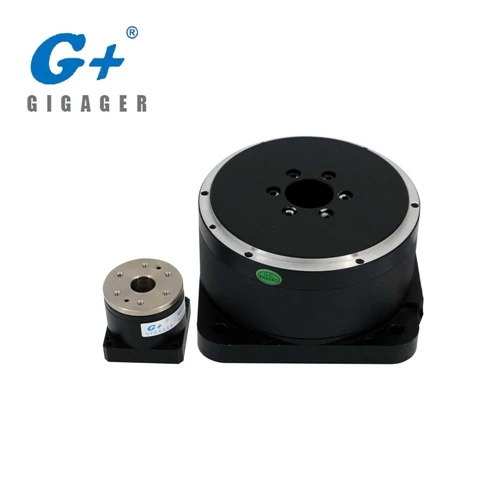
In automated assembly,inspection,machining,and packaging lines,achieving precise,reliable,and efficient intermittent transfer and positioning of workpieces between multiple stations is key to enhancing production efficiency and quality. The cam indexer (also known as a cam divider) and the hollow indexing table are two core mechanisms that fulfill this function. Due to their differing principles and characteristics,each holds irreplaceable advantages in specific application areas.
Ⅰ,Cam Indexer (Cam Divider)
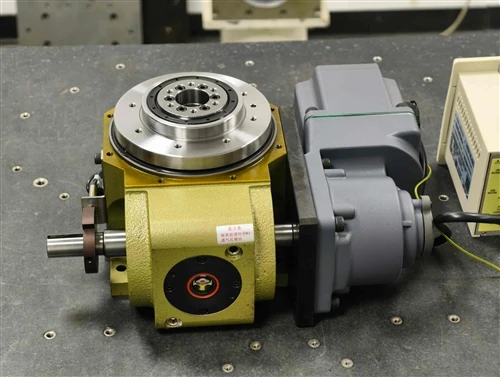
The cam indexer is a purely mechanical intermittent motion mechanism. Its core lies in the conjugate meshing between the curved surface cam on the input shaft and the precision rollers (followers) on the output turret.


Working Principle: The servo motor or standard motor drives the continuous rotation of the input shaft. The cam profile curve forcibly pushes the rollers,converting the continuous rotary input into intermittent indexing rotation (index-dwell-index) of the output shaft.
Core Construction:
Curved Surface Cam: Precisely calculated and machined to ensure smooth motion curves (e.g.,modified sine,modified trapezoidal),enabling smooth acceleration transitions and reducing impact.
Roller Turret: Multiple precision needle roller bearings are evenly distributed,making multi-point contact with the cam,offering high load capacity and rigidity.
Housing: Made of high-strength cast iron or cast steel,ensuring overall rigidity.
Motion Characteristics: The motion law (dwell-to-index time ratio,acceleration curve) is determined by the Motion Curve.Once selected,it is fixed and unchangeable.Its dwell period features mechanical self-locking,allowing it to withstand significant radial/axial loads without the need for an additional brake.

Ⅱ,Hollow Indexing Table (Servo Indexing Table)
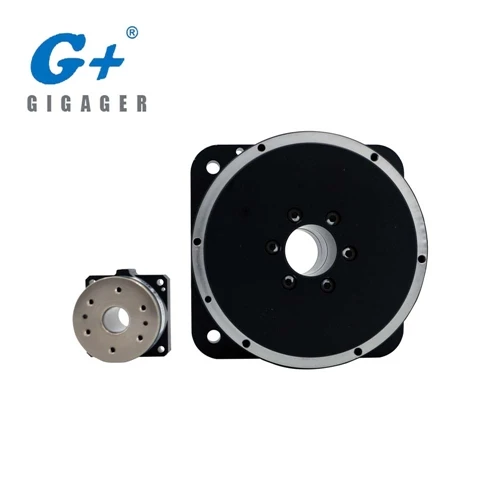
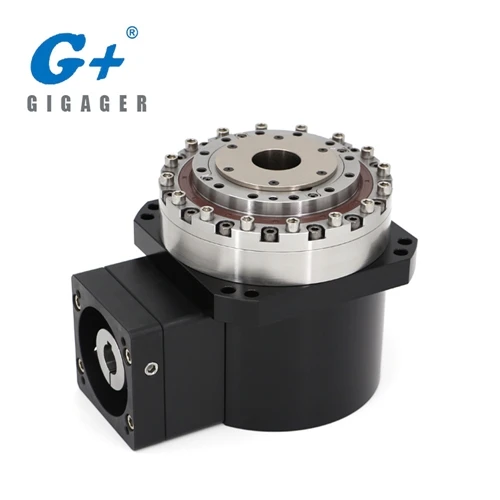
The hollow indexing table is a mechatronic,high-precision indexing device. It is essentially a modular product integrating a high-torque servo motor,a high-rigidity precision speed reducer (typically planetary or harmonic drive),and a high-resolution encoder.

Working Principle: The host controller (PLC or motion controller) sends pulse or communication commands to the servo drive,which drives the built-in servo motor to rotate. The torque is amplified and precision is enhanced by the speed reducer,ultimately driving the output disc to rotate to the specified angle.
Working Principle: The host controller (PLC or motion controller) sends pulse or communication commands to the servo drive,which drives the built-in servo motor to rotate. The torque is amplified and precision is enhanced by the speed reducer,ultimately driving the output disc to rotate to the specified angle.
Core Construction:
High-Precision Speed Reducer
The core transmission component,providing a high reduction ratio for high torque output and extremely low backlash (even zero backlash).
Absolute Encoder
Provides high-resolution feedback for closed-loop control,ensuring positioning accuracy.
Hollow Shaft Structure
Features a large central through-hole,facilitating the passage of lines (pneumatic,electrical,vision cables) for neat cable management.
Motion Characteristics: The motion law (angle,speed,acceleration,dwell-to-index time ratio) is fully programmable,offering extremely high flexibility. When stationary,locking relies on the electromagnetic holding force (brake) of the servo motor.

Ⅲ,Core Performance Comparison


Ⅳ,Application Selection Guide
Scenarios Favoring Cam Indexers:
1.High-Speed,Heavy-Load,Fixed-Cycle Production Lines
Scenarios:
Multi-station rotary assembly machines; High-speed stamping feeders; Bottle cap capping machines;
Large material processing turntables
Reason:
The indexer's stability at high speeds,reliability of mechanical self-locking,and strong impact resistance make it the preferred choice for such conditions. Its fixed motion cycle is easily synchronized with automated line cycles.
2.Applications with Stringent Rigidity Requirements
Scenarios:
Turntables involving direct machining operations like milling,drilling, or tapping.
Reason:
Significant cutting forces exist between the tool and workpiece during machining. The "rigid wall" characteristic of the indexer's dwell period effectively resists vibration and displacement caused by cutting forces,ensuring machining accuracy.
3.Relatively Harsh Environments or Lines Requiring Extremely High Reliability
Scenarios:
Foundry,forging,food packaging environments with oil,dust,or temperature/humidity variations.
Reason:
The purely mechanical structure offers greater tolerance to harsh environments,has fewer potential failure points,and provides high long-term operational reliability.
Scenarios Favoring Hollow Indexing Tables
1.Multi-Variety, Small-Batch Flexible Production
Scenarios: Inspection stations with frequent product changeovers,3C product testing stations,personalized packaging stations.
Reason: The number of stations and indexing angles (e.g., non-equal division) can be quickly changed via software without replacing any mechanical components,significantly reducing changeover time.
2.Need for Complex Motion Patterns or Vision Coordination
Scenarios: High-precision visual inspection (e.g., 360° appearance check),laser engraving,follow-type dispensing/welding.
Reason: Can communicate in real-time with the host controller to achieve "electronic cam" functions,enabling speed or position synchronization during rotation. The hollow structure facilitates the passage of camera cables or laser head lines,preventing cable entanglement.
3.Space-Constrained Equipment Requiring Centralized Cable Routing
Scenarios: Robotic arm end-of-arm rotary grippers,compact multi-station testers.
Reason: The hollow shaft provides a perfect channel for pneumatic lines,electrical wires,and vacuum tubes,resulting in a clean equipment appearance and reducing interference and wear from external moving cables.
4.Special or Non-Standard Indexing Angle Requirements
Scenarios: Requiring an odd number of stations (e.g., 5, 7) or special angles (e.g., 15°, 72°).
Reason: No need to customize special cams; any indexing angle can be achieved through software settings,saving customization cost and time.
In summary,cam indexers and hollow indexing tables,as two core components in the field of precision automation,represent the technological directions of mechanical reliability and mechatronic flexibility,respectively. Indexers excel in high-speed,heavy-load,high-rigidity,and harsh-environment fixed-cycle production lines due to their purely mechanical structure,high-speed and heavy-load capability,and mechanical self-locking characteristics. In contrast,hollow rotary tables,with their fully programmable motion control,flexible angle settings,hollow routing advantages,and good vision coordination capabilities,are better suited for flexible production,multi-variety changeovers,and complex synchronized operation scenarios. In practical applications,the appropriate core indexing mechanism should be scientifically selected based on production cycle,load conditions,environmental requirements,and automation flexibility needs to maximize equipment efficiency and production adaptability.