Ⅰ.Product Overview
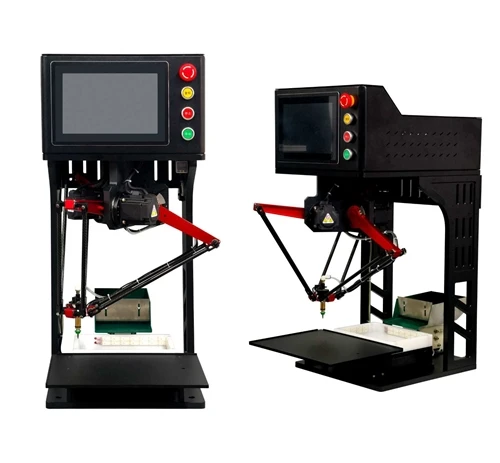
The Delta Robot Flexible Feeding System integrates the Delta parallel robot, machine vision, and the flexible vibratory feeder. Designed for high-speed feeding, sorting, positioning, tray loading, and assembly of small components. The vision system identifies the position and orientation of each part, while the robot automatically picks and accurately places the parts at the required position.
It suits for automated feeding of various irregular, thin, fragile, and small workpieces. Its core purpose is to solve the pain points of traditional feeding methods: vibratory feeders can only handle workpieces of a single specification and are prone to jamming; manual feeding is inefficient, has large errors, and is costly.
Ⅱ.Core Structure and Operating Principle
1. Core Structure
The Delta robot feeding system features a compact and modular design. It mainly consists of four key systems that work together to complete the entire automated feeding process, from material identification and positioning to picking and placement.

① Motion Mechanism
The motion mechanism mainly consists of a top stationary platform, 4 arms, parallelogram linkages, and an end moving platform. The servo motors are mounted on the stationary platform and do not move with the arms, which reduces the moving inertia and improves stability and responsiveness during high-speed operation. The parallelogram mechanism also helps maintain the horizontal orientation of the end effector, reducing part displacement or overturning during handling.
②Vision Identification & Positioning System
The vision system is the key sensing module of the feeding system. It mainly consists of camera, lighting system, and vision software. It captures images of randomly positioned parts in real time and identifies their position, orientation, and size. Based on predefined criteria, the system can identify qualified parts and provide their coordinate information to the robot for accurate picking.
③ Flexible Gripping Mechanism
The gripping is responsible for directly picking and handling the parts. Vacuum suction cups are commonly used, together with independent air circuits and check valves. When some suction cups do not contact a part, the system can minimize air leakage and maintain the overall vacuum pressure, improving gripping stability. Customized suction cups or grippers can also be selected according to the shape, material, and surface characteristics of different parts for flexible and damage-free handling.
④Intelligent Control System
The intelligent control system is built around a PLC and servo control system, together with vision and vacuum monitoring modules. After receiving positioning data from the vision system, it controls the robot to perform picking and placement according to the programmed trajectory while monitoring the gripping status in real time. The control system can also communicate with peripheral equipment such as flexible feeders, conveyors, and rotary stations to achieve fully automated feeding operations.
2. Working Principle
The parts are first distributed and separated by the flexible feeder before entering the vision inspection area. The vision system detects the position, orientation, and status of each part and sends the coordinates to the Delta robot. Based on the vision data, the robot quickly performs picking, rotation, and placement to achieve continuous automatic feeding.
Ⅲ.Key Advantages
Compact Footprint, Flexible Deployment:The robot's integrated base creates an ultra-compact structure for quick, hassle-free setup. It dramatically reduces floor space and seamlessly fits into tight workshop layouts.
Lightweight, High-Speed, Precision & Stability:The lightweight arm enables rapid response and high-throughput pick-and-place. Exceptional accuracy and smooth motion ensure continuous and stable production.
Adaptable & Feature-Rich:The end-of-arm tooling enables rapid changeovers and seamlessly integrates with vision systems, flexible vibratory feeder, labelers, and other peripherals. Real-time tracking and a full suite of communication interfaces ensure quick, hassle-free deployment across sorting, tray arraying, and precision assembly for small parts.
Easy to Operate, Quick Changeover:The smart operating system is designed for frontline staff-material modeling and program setup can be mastered with little to no training. Complete changeover for new parts takes just minutes, ensuring efficient high-mix, low-volume production with minimal downtime.
Ⅳ.Typical Applications
The Delta robot feeding system is mainly designed for high-speed, precise, and flexible pick-and-place operations, particularly for short-distance and high-frequency handling applications.

Electronics:
Feeding, sorting, and tray loading of chips, resistors, capacitors, connectors, and other precision electronic components.
Food & Beverage:
Feeding, organizing, and case packing of bagged food, pastries, nuts, and other lightweight products.
Hardware & Plastics:
Automatic feeding and sorting of small hardware parts, plastic components, sealing rings, and other small parts.
Packaging & Printing:
High-speed pick-and-place, organizing, and case packing of books, gift boxes, bags, labels, and similar products.
New Energy:
Flexible feeding and handling of small battery-related components, insulating parts, and other precision components.
Ⅴ.Conclusion
The Delta robot feeding system is an important solution for flexible automated feeding. By combining high-speed parallel robotics, machine vision, flexible feeding, and intelligent control, it improves production efficiency while providing greater adaptability to different products and production processes.
For applications requiring high-frequency pick-and-place, precise positioning, and flexible multi-product production, the Delta robot can effectively reduce manual operations and improve the automation level and stability of the production line.