In automated production lines, workpieces often need to be arranged at different spacings during loading, processing, inspection, or handling. For example, workpieces may be positioned close together during loading, while a larger spacing may be required at subsequent processing or inspection stations.
Traditional solutions often require additional handling or positioning mechanisms. A pitch changer uses a mechanical transmission structure to adjust the spacing between multiple workpieces simultaneously, helping simplify equipment design and improve production efficiency.
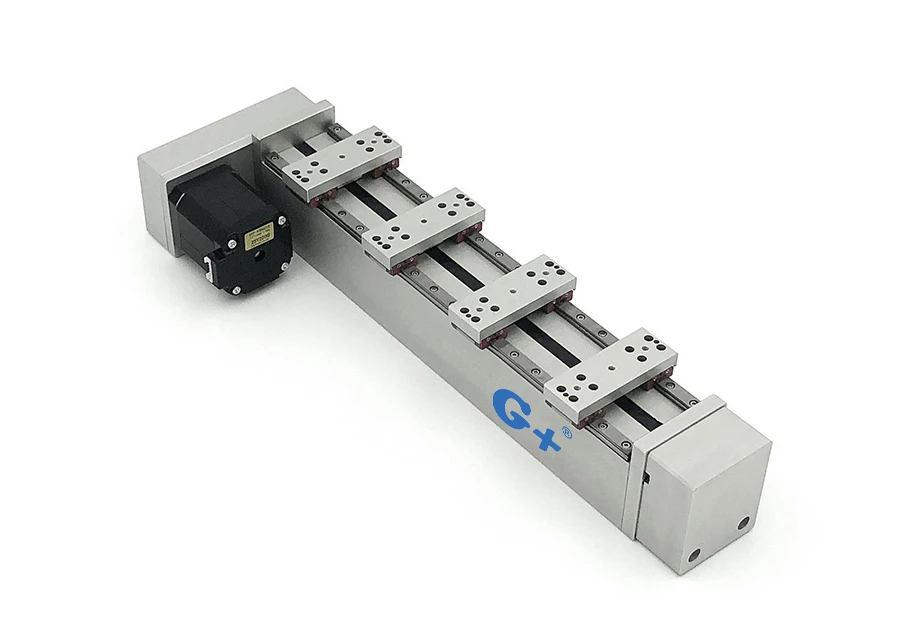
This article introduces the working principle, typical applications, and key selection factors of pitch changers to help readers understand their role in automated production.
I. What Is a Pitch Changer?
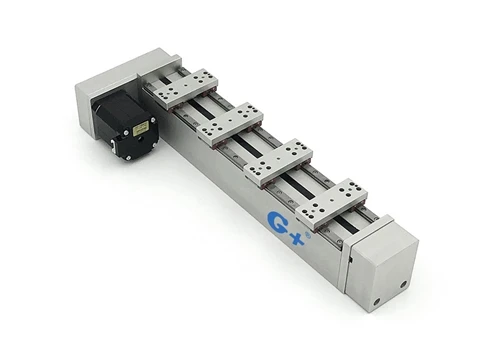
A pitch changer is an automated mechanical mechanism designed to synchronously adjust the center-to-center distance between multiple workpieces or operating units.
By changing the distance between adjacent workpieces or operating positions, it enables simultaneous pitch expansion and reduction. For example, workpieces initially arranged at a center distance of 20 mm can be repositioned to a center distance of 40 mm. The spacing can also be reduced when required by the production process.
Unlike a conventional linear module, which mainly moves a single component along a straight line, a pitch changer adjusts the relative positions of multiple sliders to change the spacing between workpieces.
II. Working Principle of a Pitch Changer
A pitch changer typically uses a drive mechanism to move multiple sliders or operating units. These sliders move relative to each other according to a predefined mechanical transmission relationship, allowing the spacing between workpieces to be adjusted.
During pitch expansion, the distance between workpieces increases. During pitch reduction, the distance decreases. With an appropriately designed mechanical structure, multiple operating positions can be adjusted synchronously according to a predefined motion pattern.
III. The Role of Pitch Changers in Automated Production
Different production processes may require different workpiece spacings. For example, workpieces may be arranged closely together during loading to save space, while larger gaps may be needed during processing, inspection, or assembly to provide sufficient clearance for fixtures, tools, or inspection components.
A pitch changer synchronously adjusts the center distance between multiple workpieces, allowing their arrangement to match the requirements of different production stages while reducing the need for separate adjustment mechanisms.
IV. Pitch Changers vs. Conventional Linear Modules
Although both pitch changers and conventional linear modules can produce linear motion, they serve different purposes. A conventional linear module mainly drives an operating component along a straight line, whereas a pitch changer focuses on adjusting the relative spacing between multiple operating positions.
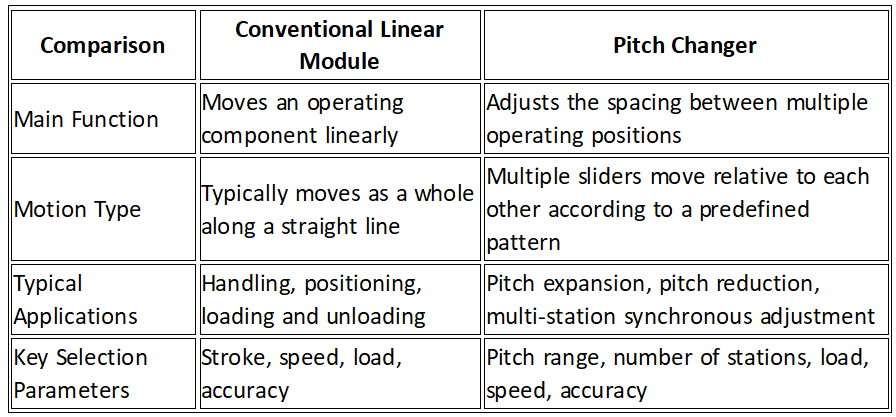
In simple terms, a conventional linear module is designed to move an operating component, while a pitch changer is designed to adjust the spacing between multiple workpieces.
V. Typical Applications of Pitch Changers
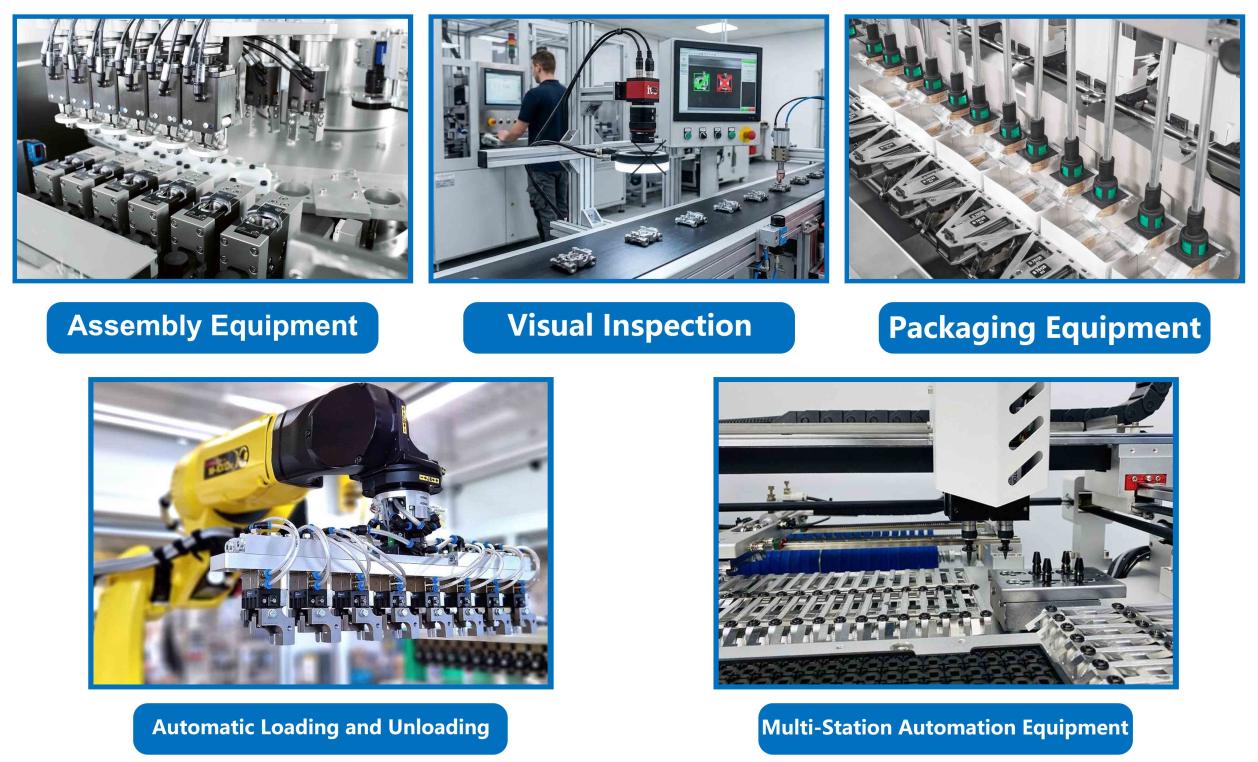
Pitch changers are suitable for automated equipment that handles multiple workpieces simultaneously and requires changes in their arrangement between different production stages.
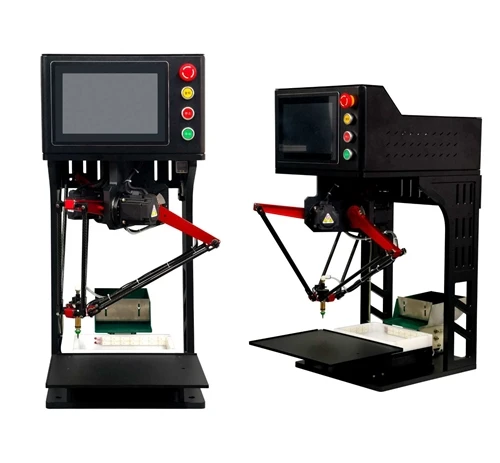
Automatic Loading and Unloading: When a robot picks up multiple workpieces simultaneously, a pitch changer can adjust their spacing to match the positions of the next processing stations.
Visual Inspection: Workpiece spacing can be adjusted according to inspection requirements, helping prevent adjacent workpieces from obstructing each other and providing sufficient clearance for image capture and inspection.
Assembly Equipment: The spacing between multiple components can be adjusted synchronously to match different assembly station positions and support multi-station assembly operations.
Packaging Equipment: Workpiece spacing can be adjusted according to packaging specifications and equipment layout to meet the requirements of subsequent packaging processes.
Multi-Station Automation Equipment: Multiple operating positions can be adjusted synchronously, reducing the need for separate adjustment mechanisms and helping optimize equipment layout.
VI. Key Selection Factors for Pitch Changers
Selecting a suitable pitch changer requires consideration of the actual process requirements and the following key parameters:
Number of Stations: Determine how many workpieces or operating positions need to be adjusted simultaneously. This affects the mechanical structure, slider arrangement, and drive configuration.
Initial and Target Pitch: Specify the center distance before and after adjustment, such as changing from 20 mm to 50 mm, or reducing a larger spacing to a smaller one.
Pitch Range: Define the minimum and maximum spacing required, as well as the specific pitch changes between individual stations.
Load: Consider the weight of the workpieces, fixtures, and other components carried by each slider, together with load distribution and motion-related inertia.
Motion Speed and Acceleration: Determine the required speed and acceleration during pitch adjustment according to the production cycle.
Positioning Accuracy and Repeatability: Define the required positioning accuracy and repeatability based on the needs of processes such as assembly and inspection.
Installation Space: Consider the overall dimensions and mounting orientation of the pitch changer, as well as its spatial relationship with robots, fixtures, and conveying equipment.
Drive Method and Motor Configuration: Select the appropriate drive method, motor specifications, and mounting interface according to motion requirements. Motor compatibility with the transmission mechanism should also be considered.
Slider Motion Relationship: Define how the sliders should move, such as symmetrical pitch expansion, one-sided movement, or other specific adjustment patterns, to ensure the mechanism meets the actual process requirements.
VII. Key Advantages of Pitch Changers
Under suitable application conditions, pitch changers offer several advantages:
Synchronous Pitch Adjustment: Multiple sliders adjust their spacing simultaneously according to a predefined motion pattern.
Compact Structure: Helps reduce the space occupied by multiple independent adjustment mechanisms.
Reduced Number of Drive Mechanisms: With a suitable mechanical design, one drive mechanism can move multiple operating positions.
Flexible Workpiece Arrangement: Supports different spacing requirements through pitch expansion and reduction.
VIII. GIGA GPM Series Pitch Changers
The GIGA GPM Series Pitch Changers are designed for multi-station pitch adjustment in automated equipment and can be used together with robots, fixtures, linear motion systems, and conveying mechanisms.
For product selection, factors such as the number of stations, initial and target pitch, load, motion speed, and installation space should be evaluated. For applications requiring special pitch ranges or multi-station synchronous motion, please contact the GIGA technical team to discuss the specific application and configuration requirements.
Conclusion
A pitch changer uses a mechanical transmission structure to synchronously adjust the spacing between multiple workpieces or operating positions. It is suitable for automated equipment that needs to change workpiece arrangements between different production stages.
When selecting a pitch changer, consider the number of stations, pitch range, load, motion speed, positioning accuracy, and installation space to identify a solution that meets the actual application requirements.