An electric cylinder (also known as an electric actuator or linear actuator) is a precision actuation element in industrial automation that converts the rotational motion of an electric motor into linear reciprocating motion through a precision mechanical transmission mechanism.
Simply put, it combines the functional characteristics of traditional pneumatic cylinders and hydraulic cylinders, but uses electricity as its direct power source, achieving cleaner, more precise, and more controllable linear motion.
Core Components and Working Principle
An electric cylinder mainly consists of four subsystems that work together to perform precise conversion from electrical to mechanical energy.
Drive system: Typically uses an AC servo motor or stepper motor to provide rotational power. Some models integrate a reduction gear to increase torque.
Transmission system: This is the core component. A screw-nut pair converts the motor's rotational motion into linear motion of the nut (piston). Common types include ball screws (high efficiency, high precision), planetary roller screws (heavy load, high precision), and lead screws (low speed, self-locking).
Guidance system: Built-in guide rails or guide bushes ensure smooth, non-deflected movement of the piston rod.
Control system: Includes encoders, sensors, etc., that monitor position, speed, thrust and other information in real time and feed it back to the controller, enabling closed-loop control.
Working process: Control unit (e.g., PLC) sends command → servo driver drives motor to rotate → screw converts rotation into linear motion of nut → encoder provides real time position feedback to complete precise closed loop control.
Different Types of Electric Cylinders
Electric cylinders can be classified from several perspectives:
By transmission mechanism: Ball screw type (most widely used); Planetary roller screw type (extreme heavy-duty high precision); Lead screw type (low speed, self-locking)
By motor type: Servo motor type (high precision/speed, mainstream); Stepper motor type (cost-effective when precision is moderate); DC/AC motor type
By mounting configuration: Inline (compact); Folded/parallel (short overall length, saves space); Vertical (extremely short overall length)
By motion form: Piston rod type (traditional push-pull); Slide table / rodless type (sliding table moves, higher load capacity)
By telescopic combination: Single-stage and multi-stage (larger stroke ratio but lower load capacity)
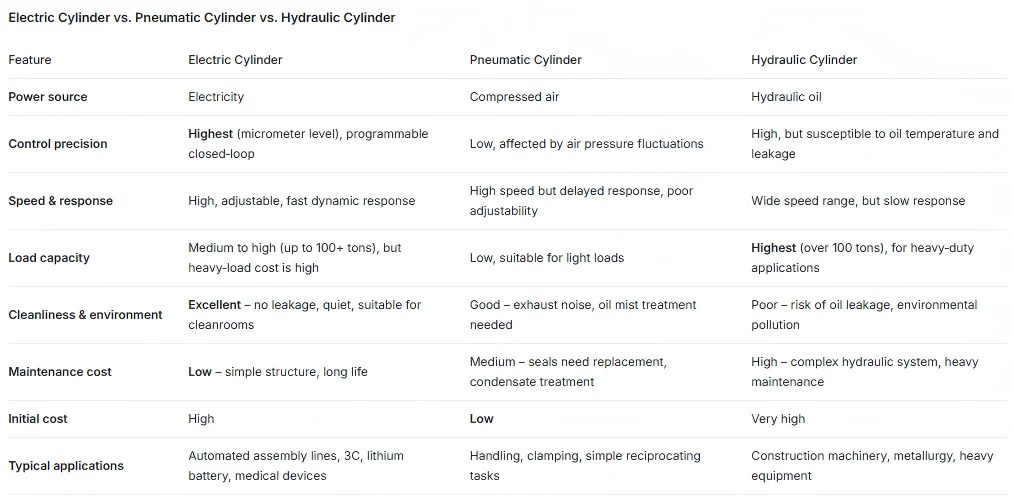
Advantages, Disadvantages, and Comparisons
Key Advantages of Electric Cylinders
High positioning accuracy: Closed loop servo control achieves repeatability of ±0.01mm or even ±0.005mm, far exceeding pneumatic cylinders.
Energy saving and clean: Consumes power only during motion; energy usage is only 10 30% of pneumatic systems. No risk of oil leakage, high cleanliness.
Flexible and controllable: Speed, position, and thrust can be programmed; easy integration with PLC/PC for flexible manufacturing.
Low maintenance: Simple structure, low failure rate. Only regular lubrication and cleaning needed; long service life.
Smooth and quiet operation: Electronic cushioning, no impact or exhaust noise, very low vibration.
Strong adaptability: Good sealing; protection rating up to IP66; works reliably in harsh environments.
Limitations
Higher initial cost: The combined cost of the electric cylinder, servo drive, and control system is usually higher than that of an equivalent pneumatic cylinder.
Poor impact resistance: Internal precision components like ball screws are sensitive to shock loads; not suitable for frequent impact applications.
Sensitive to overload: Motors and drives have overload protection, but the load must be carefully considered during selection to avoid overheating alarms from prolonged overload.
Application Fields
Leveraging its advantages, the electric cylinder has become a core actuation element in modern industrial automation:
Automated production lines: High precision pressing, positioning, clamping – e.g., motor bearing press fitting, PCB pin pressing.
Electronics & semiconductors: Wafer handling, chip placement, screen lamination – operations requiring micron level precision.
Lithium battery & new energy: Precise tension control and positioning during stacking, winding, and formation processes.
Testing & measurement: As dynamic test platforms for material fatigue testing, spring force measurement, etc.
Logistics & warehousing: AGV lifting, sorting pushers, shuttle forks in automated warehouses.
Medical & life sciences: Surgical robots, precise adjustment of medical beds, micro syringe pumps.
Industrial robots: As an external linear axis (7th axis) to extend the robot's working range.
Aerospace: Motion platforms for flight simulators, positioning of aircraft components.