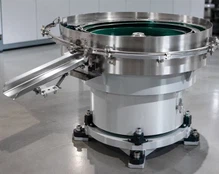
In modern automation systems, the vibratory bowl feeder is a widely used feeding device for sorting and orienting parts. It automatically aligns randomly arranged components into a consistent direction and delivers them continuously to the next production process. By replacing manual feeding, it helps improve efficiency, maintain consistency, and reduce labor costs.

1. Working Principle
A vibratory bowl feeder consists of a vibratory bowl, base unit, vibratory base, controller, and feeding track. These components work together to generate controlled vibration, enabling automatic parts movement and orientation.
During operation, the vibratory base generates consistent vibration that drives parts to move along the spiral track inside the bowl. Through the combined effect of vibration and gravity, parts are transported upward and guided into the correct orientation.
2. Key Components of Automatic Parts Feeding System
A standard automatic parts feeder system includes the following key components:
• Vibratory Bowl
Holds bulk parts and guides them into the feeding track.
• Base Unit
Supports the feeder structure and provides installation stability.
• Vibratory Base
Generates controlled vibration to drive parts movement and feeding.
• Controller
Adjusts vibration frequency, amplitude, and feeding speed.
• Customized Track
Designed according to part geometry for orientation and sorting.

3. Feeding and Orientation Process
Driven by vibration, parts move along a spiral track where orientation mechanisms such as grooves, baffles, or shape-based structures filter out incorrectly positioned components. Only properly oriented parts continue moving upward along the track and are delivered to the outlet for transfer to the next production stage. This process enables continuous, stable, and automated feeding.
4. Applications
Vibratory bowl feeders are widely used in industries where small parts require sorting, orientation, and automatic feeding. They are suitable for both precision components and high-volume production environments, helping improve efficiency and consistency across automated assembly lines.
Electronics & Hardware Industry
Used for components such as resistors, capacitors, connectors, screws, nuts, and springs, ensuring stable and high-speed feeding in assembly and production lines.
Medical & Food Industry
Applied in hygienic production environments for feeding capsules, tablets, candies, nuts, and other granular products, ensuring clean and precise handling.
Automotive Industry
Used in automotive manufacturing lines for feeding screws, springs, fasteners, and other mechanical components to support efficient automated assembly.
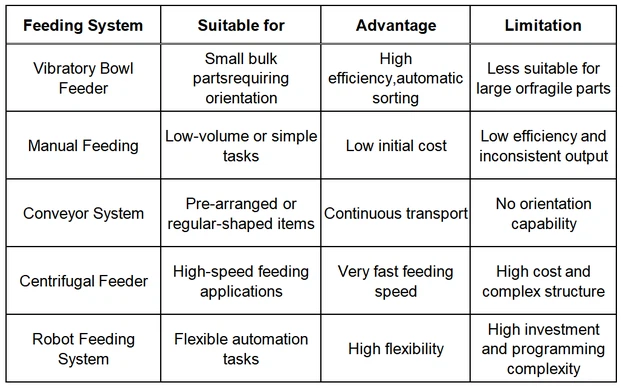
5.Comparison with Other Feeding Systems
|
|
|
|
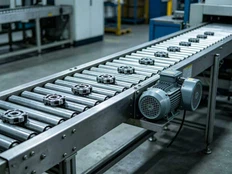 |

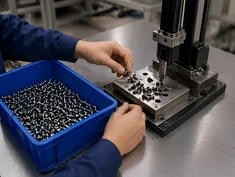
Different feeding systems are designed for different production requirements. Compared with other feeding solutions, vibratory bowl feeders provide a balanced combination of efficiency, flexibility, and cost-effectiveness, especially for small parts that require orientation.
Advantages and Limitations
Vibratory bowl feeders are highly efficient for handling small bulk parts and can automatically sort and orient components with stable performance. However, they may not be suitable for large, fragile, or highly irregular-shaped products and often require customization based on part design.
6. Advantages
·Automated feeding, replacing manual labor
·Improved production efficiency
·Reduced labor cost
·Customizable design based on application requirements
·Stable and reliable operation
7. Selection Guide
When selecting a vibratory bowl feeder system, several factors should be evaluated to ensure stable feeding performance and compatibility with the production process.
• Part Characteristics
Consider the size, shape, material, weight, and surface condition of the parts. Products that are prone to jamming, overlapping, or scratching may require customized track design.
• Feeding Requirements
Determine whether orientation, feeding speed, positioning accuracy, or continuous operation is required. Different applications may require different feeding configurations.
• Production Environment
Industry conditions such as cleanliness, humidity, vibration sensitivity, and production volume should be considered when selecting feeder materials and design.
• Integration with Automation System
Consider compatibility with downstream equipment such as robotic arms, conveyors, inspection systems, or assembly machines.
• Capacity and Refill Requirements
For high-volume production, optional hopper systems may be added to reduce manual refilling frequency and maintain continuous feeding.
In general, vibratory bowl feeders are suitable for a wide range of parts that require controlled orientation, stable feeding, and automated transfer in industrial production.
8. Conclusion
The vibratory bowl feeder is an essential component in modern automated production systems. It helps improve efficiency, ensure consistent feeding, and support high-volume manufacturing across multiple industries. With its flexibility and reliability, it remains one of the most widely used feeding solutions for small parts automation.